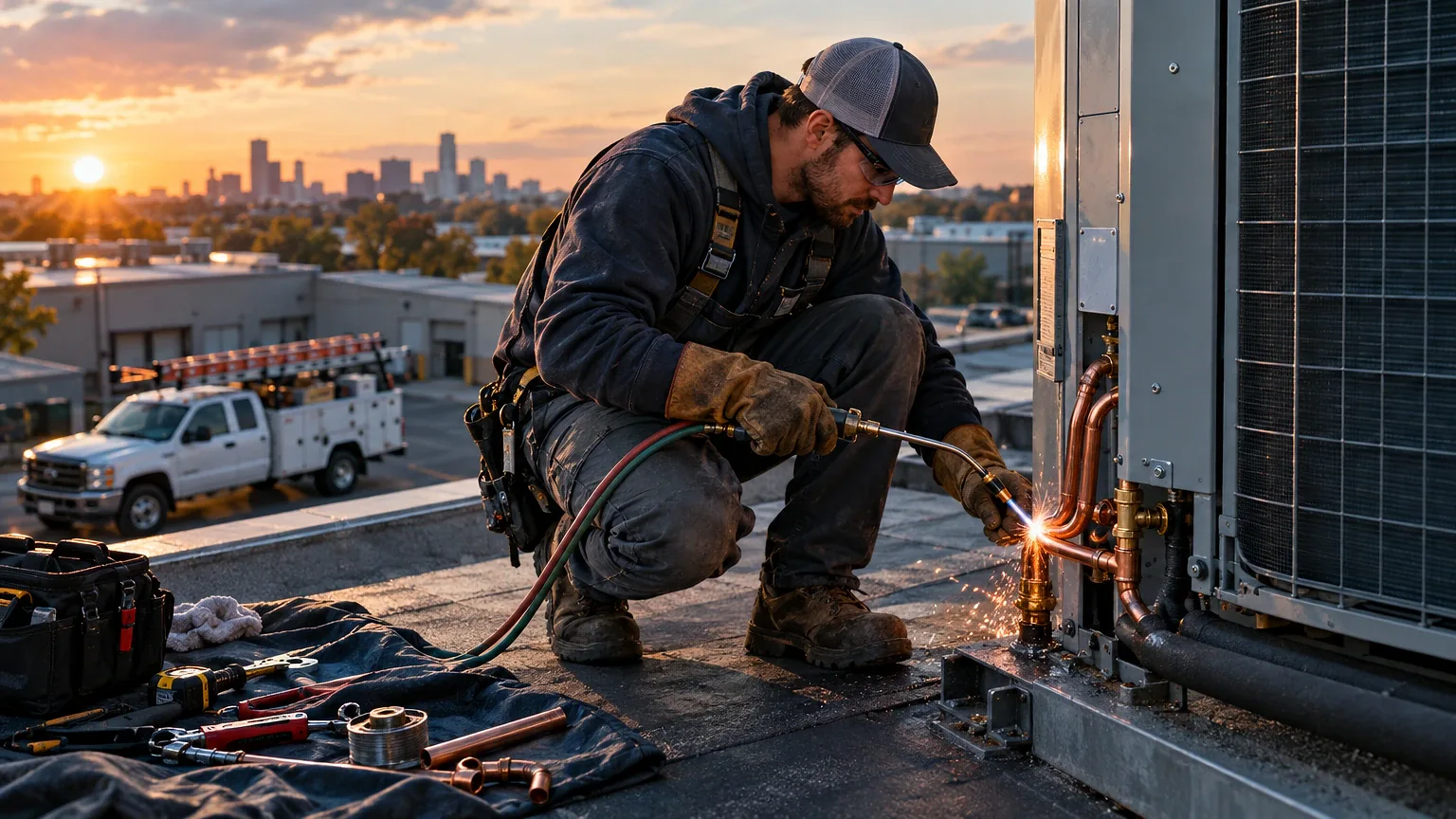
Your tech is on a roof, brazing a line set, and a spark catches the underlayment. Or a customer slips on ice you tracked in during a no-heat call. Either one can wipe out a season of profit. The difference is whether your HVAC business insurance covers it.
HVAC business insurance isn’t one policy. It’s a stack of coverages that wraps the risks your crews face daily, on ladders, in crawlspaces, around refrigerant and flame. Get the stack wrong and a single claim can cost more than ten years of premiums. Treat it as a fixed cost of doing business, the same way you budget for HVAC maintenance costs.
Where General Liability Fits in Your HVAC Business Insurance Stack
General liability handles the basics: a customer trips over your tool bag, or your installer nicks a water line and floods a basement. Most contractors carry $1 million per-occurrence limits with a $2 million aggregate, which satisfies the GC requirements on most commercial jobs.
But GL has gaps that matter in this trade. It won’t touch a work-related injury to your own tech, that’s workers’ comp territory. It won’t cover your service van when someone rear-ends it on the way to a call. And it typically excludes damage to the HVAC unit you’re actively working on, that’s where installation floater or tools-and-equipment coverage steps in.
A real example: a two-man crew swaps out a rooftop package unit and the crane operator drops it partway, cracking the condenser coil. GL won’t pay for the unit itself since it’s “your product” under installation. You need an inland marine or installation floater endorsement specifically for equipment in transit or mid-install. Shops that skip this eat the replacement cost themselves, often $4,000 to $9,000 on a mid-size commercial unit.
Workers’ Comp and the Real Cost of a Field Injury
Workers’ comp isn’t optional in nearly every state once you have employees, and HVAC crews get hurt more than office workers. Falls from ladders, back strain from compressor handling, burns from brazing torches, these are the claims that drive your experience modifier (e-mod) up or down.
Your e-mod is the single biggest lever on your comp premium. A rating of 1.0 is average for your class code. Run a clean safety record for three years and you can drop to 0.85 or lower, saving real money on every policy term. Run a rough stretch with two lost-time claims and you could see 1.3 or higher, meaning you’re paying 30% more than your peers for the same payroll.
Classify your workers correctly too. Service techs, installers, and sheet metal fabricators often fall under different class codes with different rates. Misclassify a journeyman installer under a lower-risk office code to save premium, and an audit will catch it, then bill you the difference plus penalties. The National Council on Compensation Insurance sets most of these class codes and experience rating rules used by state-regulated carriers.
Commercial Auto for Service Vans and Box Trucks
Every van with your logo on the side needs commercial auto coverage, not a personal policy with a business-use rider slapped on. Personal insurers can deny claims outright if they learn you used the vehicle for paid service calls.
Commercial auto for HVAC fleets typically runs liability limits matching your GL, often $1 million combined single limit. It should also include physical damage coverage for the van itself. Add hired and non-owned auto (HNOA) coverage if techs ever drive personal vehicles to jobsites or pick up parts in their own trucks. Without HNOA, a tech crashing their personal pickup while running to the supply house for a capacitor leaves a coverage hole that lands on your business.
Here’s where shops get burned: a tech loads a used compressor and a reclaimed R-410A tank into the van for safe disposal. An accident happens, the tank ruptures, and now you’ve got a pollution claim layered on top of auto damage. Standard commercial auto often excludes pollution from cargo. A pollution liability endorsement, sometimes called contractors pollution liability (CPL), closes that gap for crews handling refrigerant daily.
Picking Between Package Policies and Building Coverage A La Carte
Option A: Business Owner’s Policy (BOP)
A BOP bundles general liability, commercial property, and business interruption into one policy, usually with a lower combined premium than buying each separately. Picture a small HVAC shop with one location and under $2 million in annual revenue. For that shop, a BOP is often the fastest way to get compliant coverage.
The tradeoff: BOPs come with pre-set limits and exclusions you can’t always negotiate. Many standard BOPs cap equipment coverage low, forcing you to add inland marine separately anyway. You also may not qualify for heavy commercial rooftop work or larger fleets. Insurers price those as higher-risk profiles outside standard BOP eligibility.
Option B: Building a Custom Commercial Package
A custom package lets you set your own limits on each line. GL, workers’ comp, commercial auto, equipment floater, and pollution liability are each negotiated and priced on their own. This fits larger HVAC operations running 10+ trucks, doing new construction mechanical work, or holding commercial contracts that demand specific additional-insured language and higher aggregate limits.
The downside is complexity and cost. You’re managing multiple renewal dates potentially, more paperwork, and a higher base premium since you lose the bundling discount. Shops under 15 employees rarely need this route unless contract requirements force it. Big GCs often mandate $2 million umbrella limits. BOPs don’t reach that without a separate excess policy stacked on top.
Most growing HVAC contractors start with a BOP and migrate to a custom package once revenue crosses roughly $3 million. A commercial contract demanding higher limits can force the same move.
Five HVAC Business Insurance Coverages Most Shops Forget
Most shops buy standard GL and comp first. Shops skip these five until a claim exposes the gap.
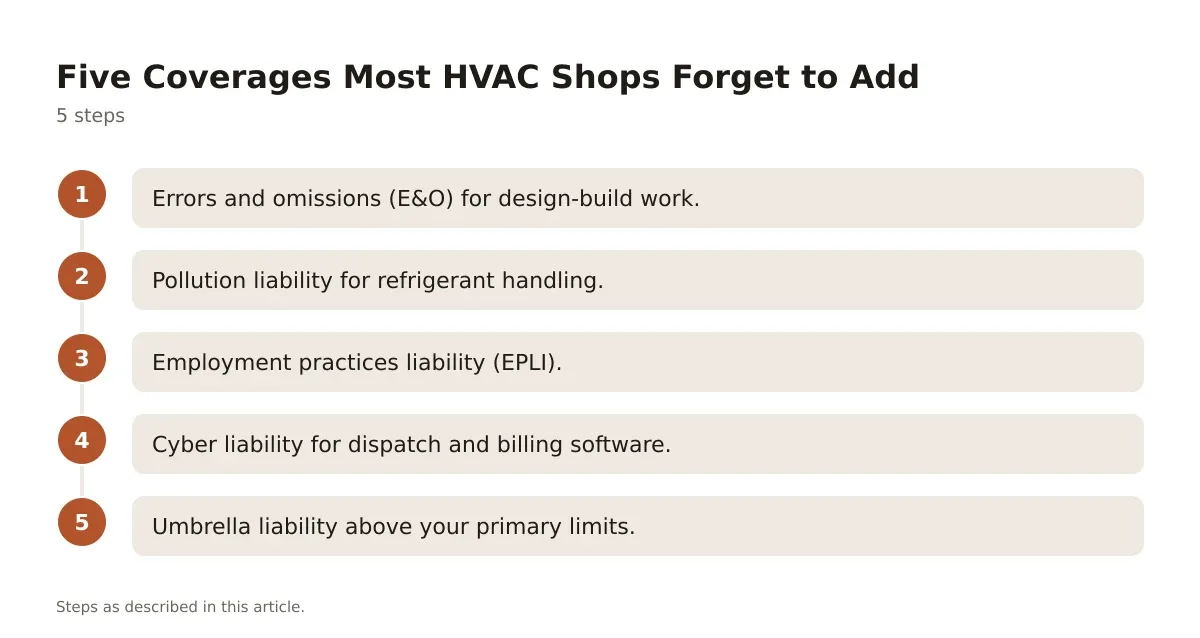
- Errors and omissions (E&O) for design-build work. If you’re sizing systems, doing load calcs, or recommending equipment and the install underperforms, a pure GL policy may deny the claim as a “faulty workmanship” dispute rather than bodily injury or property damage.
- Pollution liability for refrigerant handling. Beyond the auto-transport gap mentioned earlier, a slow refrigerant leak during a commercial install can trigger environmental cleanup costs GL excludes outright.
- Employment practices liability (EPLI). Wrongful termination or harassment claims from field staff are common in high-turnover trades and aren’t covered under GL or workers’ comp.
- Cyber liability for dispatch and billing software. Shops running platforms like ServiceTitan or Housecall Pro store customer payment data and addresses, a breach triggers notification costs and potential fines under state data laws.
- Umbrella liability above your primary limits. A single serious injury claim, say a tech falls through a ceiling during ductwork and suffers permanent injury, can blow past a $1 million GL limit fast once medical costs and lost-wage claims stack up.
Carry all five and you’re covering the claims that don’t make headlines until they land on your desk.
How HVAC Business Insurance Premiums Get Set
Underwriters price HVAC risk using payroll, revenue, claims history, and the mix of work you do. A shop doing mostly residential service calls prices lower than a commercial rooftop contractor. Fall risk and equipment value climb fast on commercial jobs.
Your loss runs matter more than almost anything else. Request them from your current carrier every renewal, they show every claim filed in the past three to five years. Clean loss runs with zero lost-time injuries give your broker use to shop competitive quotes. A shop with two water-damage claims in eighteen months will see premium increases regardless of broker effort.
Ask your broker about safety credits. Carriers often discount premium for documented safety programs, OSHA 10 or 30 certification across your crew, and drive-cam systems in service vans. A fleet telematics program showing reduced hard-braking events can shave points off your auto premium at renewal. The Occupational Safety and Health Administration also publishes recordkeeping requirements that double as documentation insurers want to see.
Deductible choices matter too. Raising your GL deductible from $1,000 to $5,000 can meaningfully lower premium. Only make that move if your cash reserves can absorb several mid-size claims in a bad year without cash flow strain.
Getting Your HVAC Business Insurance Right Without Overpaying
The shops that get burned aren’t usually the ones with no insurance. They’re the ones with a policy that looks complete on paper but has exclusions nobody read closely, pollution, equipment-in-transit, subcontractor liability. Read your policy’s exclusions page before you read the declarations page. That’s where the real coverage limits live.
Work with a broker who actually writes HVAC and mechanical contractor accounts regularly, not a generalist who handles every trade the same way. Ask for their book of business in your trade specifically. A broker who understands refrigerant handling exposure and rooftop fall risk will structure your package differently than one quoting you like a general handyman service.
Review your coverage every year, not just at renewal. Revenue growth, new service lines like commercial design-build, and fleet additions all change your risk profile. A policy that fit your shop at 8 employees and 2 trucks rarely still fits at 20 employees and 8 trucks without real gaps opening up.
📋 Disclaimer: This article is for informational purposes only and does not constitute insurance, legal, or financial advice. Coverage requirements, limits, and pricing vary by state and carrier. Confirm current rules and rates with a licensed insurance broker or your state insurance department before making coverage decisions.
Frequently asked questions
How much does hvac business insurance typically cost?
Cost depends heavily on payroll, revenue, claims history, and work type, residential service runs cheaper than commercial rooftop and new construction. A small shop with a handful of techs might pay a modest annual premium for a bundled BOP. Larger fleets running custom packages pay considerably more. Get quotes from a trade-specific broker rather than estimating from generic small business averages.
Do I need separate coverage for refrigerant handling?
Standard general liability typically excludes pollution-related claims, including refrigerant leaks and improper disposal. A contractors pollution liability (CPL) endorsement or standalone policy covers cleanup costs and third-party claims tied to refrigerant release. Any shop handling R-410A, R-32, or reclaimed refrigerants regularly should carry this rather than assume GL extends to it.
Does workers’ comp cover an owner-operator with no employees?
Requirements vary by state, some exempt sole proprietors with no employees, others require coverage regardless of headcount once you’re licensed as a contractor. Many owner-operators still buy a policy voluntarily since a serious injury without comp coverage means paying medical and lost-income costs entirely out of pocket. Check your state’s workers’ comp board for the exact exemption rules in your jurisdiction.
Can I run a BOP if I also do light commercial work?
It depends on the carrier and how much commercial exposure you carry. Some BOPs allow a mix of residential and light commercial work. Commercial revenue just has to stay under a set share of total business. Heavy commercial rooftop or new construction work usually pushes you into a custom package instead. BOP equipment and liability limits often cap too low for that risk.
What happens if I’m underinsured when a big claim hits?
Once your policy limits are exhausted, the business is exposed to the remaining claim amount. Depending on your entity structure, the owner’s personal assets can be exposed too. This is exactly why umbrella liability exists, it sits above your primary GL, auto, and comp limits and picks up where they stop. Shops doing any commercial contract work should treat umbrella coverage as standard, not optional.
