Contractors who sell HVAC maintenance plans hard usually run 20 to 30 percent higher gross margins than those living call-to-call. That’s not a fluke. Recurring revenue smooths the summer-winter swing and fills the slow shoulder months with billable work.
This piece breaks down how to build, price, and staff HVAC maintenance plans that actually get renewed, not the kind that die quietly after year one.
Why HVAC Maintenance Plans Change Your Whole Business Model
A service call is a coin flip. HVAC maintenance plans are a bet you can actually model.
Think about the math. A tech running emergency no-heat calls in January books maybe 4 to 6 jobs a day, half of them diagnostic dead ends on units that just need a capacitor. A tech running scheduled tune-ups on a maintenance route can hit 8 to 10 visits a day. There’s no troubleshooting and no waiting on a customer to describe symptoms over the phone.
That efficiency shows up on the P&L. Shops with a strong maintenance base report labor utilization rates 15 to 20 points higher than those without one, because dispatch isn’t scrambling to fill Tuesday afternoon.
There’s also the retention angle. A customer on a plan calls you first when the compressor hums funny. Without a plan, they call three contractors and take the lowest bid. Angi and Google reviews are full of one-time customers who never came back. Plan members do.
What Belongs In a Residential vs Commercial Plan
Don’t sell the same HVAC maintenance plans to a homeowner and a property manager. The scope, frequency, and risk profile aren’t close.
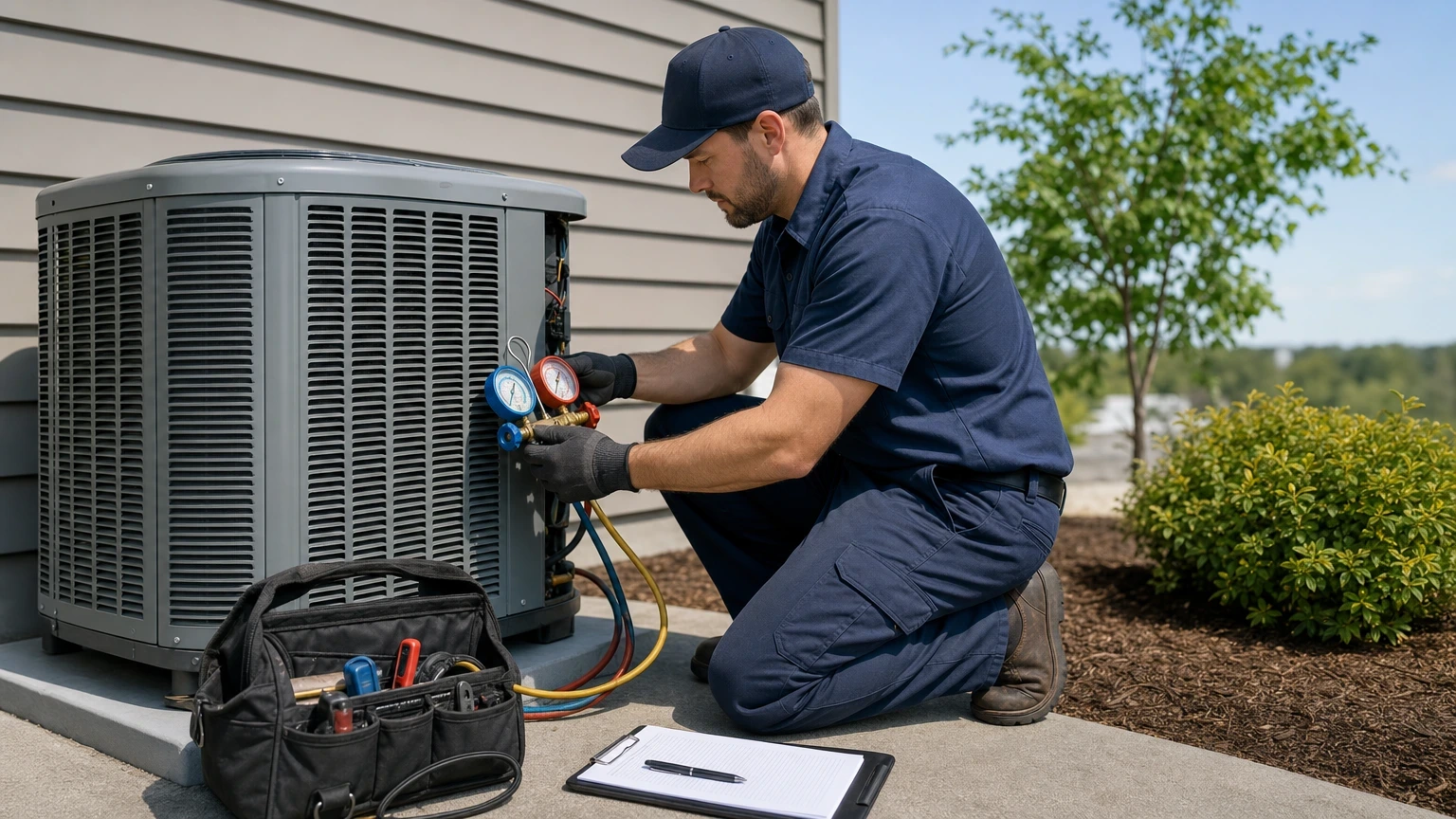
Residential plans typically run two visits a year: one spring cooling check, one fall heating check. A tune-up should include coil cleaning, refrigerant pressure check with gauges or a tool like the Testo 550, condensate drain flush, capacitor and contactor inspection, filter swap, and a blower amp draw reading. Anything less and you’re just doing a filter change with a truck roll fee attached.
Commercial plans need to scale with equipment count and criticality. A rooftop package unit serving a server room isn’t the same priority as one over a break room. Commercial agreements usually add belt tension checks, economizer inspection, refrigerant leak scans, and BAS (building automation system) alarm review if the site runs one. Quarterly visits are standard for anything with an occupancy load or process cooling tied to it.
Where contractors get burned: pricing commercial like residential, per unit, without weighting for rooftop access, lift equipment needs, or after-hours work restrictions. A 20-ton RTU on a two-story roof with no ladder access costs more to service than three residential splits combined. Price it that way.
Building HVAC Maintenance Plans and Tiers That Actually Sell
Customers don’t compare your plan to your competitor’s plan. They compare it to nothing. Make the good option look obviously worth it.
Three tiers work better than one flat offer. A basic tier covers the two seasonal visits and a discount on repairs, usually 10 percent. A mid tier adds priority scheduling, meaning same-day or next-day response instead of the standard 48 to 72 hour window, plus a bigger repair discount around 15 percent. A top tier adds waived diagnostic fees, extended parts coverage on major components like compressors and heat exchangers, and often a loyalty perk like a free duct inspection every other year.
Price the tiers so the middle one is the obvious pick, the same way HVAC equipment itself gets sold: good, better, best, with “better” doing most of the volume. Most shops find 60 to 70 percent of signups land on the middle tier when it’s positioned right.
Pricing HVAC Maintenance Plans and the Margin Targets to Hold
Undercharge on maintenance plans and you’re subsidizing them with repair revenue that may never come.
Residential plans generally price between $180 and $350 a year depending on system type and region; furnace-only or AC-only coverage sits at the low end, dual-system coverage at the high end. Whatever number you land on, check it against your fully loaded labor cost per visit, not just the tech’s hourly wage. Include drive time, materials, and admin overhead for scheduling and billing.
A maintenance visit should hold a gross margin north of 40 percent even after materials and windshield time. Are your tune-up visits running thinner than that? Either your visit is too long or your price is too low. Your tech may also be doing unpaid extra work that should be a separate repair ticket.
Commercial pricing works better per-unit-per-year rather than a flat site fee, especially on mixed equipment. A site with four rooftop units and two mini-splits should get priced per piece of equipment. Weight each one by tonnage and access difficulty. One lumped number under-recovers on the hard-to-reach units.
Autopay matters more than the price point itself. Plans billed monthly via a card on file renew at meaningfully higher rates than plans invoiced annually, because nobody has to actively decide to keep paying. Set it up in your field service software and forget about chasing checks.
Selling and Renewing HVAC Maintenance Plans Without a Script
Techs sell maintenance plans better than salespeople do, if you give them room to.
The pitch works best at the point of an actual finding. A tech notices a dirty coil or a capacitor testing at 15 percent below rated microfarads during a repair call. That’s the moment to say, “This is exactly the kind of thing we catch on our maintenance visits before it strands you without AC.” Not a script. A fact-based nudge.
Renewal is where most shops leak revenue. A plan that auto-renews on the card with a courtesy call two weeks out holds far better than one requiring a mailed invoice and a callback. Track renewal rate as its own KPI, separate from new signups; a healthy program should renew at 75 percent or better year over year. Anything under 60 percent means either the service delivery is weak or the sales conversation set expectations the visits didn’t meet.
Here’s what actually moves renewal numbers:
- A pre-visit text or email confirming the appointment window, cutting no-show cancellations
- A leave-behind report with photos of what was checked, not just a checkbox invoice
- A follow-up call or text 48 hours after the visit asking if everything’s running fine
- A loyalty discount that increases slightly after year two, rewarding tenure instead of just chasing new signups
- A clear repair-discount reminder printed on the invoice so members actually use the benefit they’re paying for
Tracking Performance With the Right Software and Metrics
You can’t manage a maintenance program off memory and a spreadsheet once you pass 150 active agreements.
Field service platforms like ServiceTitan, Housecall Pro, and FieldEdge all handle recurring agreement scheduling, autopay billing, and renewal alerts natively. The difference between them is mostly in reporting depth and how well they integrate with your existing dispatch board. If you’re already running one of these for service calls, activate the membership module before shopping for a separate tool.
The metrics worth watching monthly: active plan count, renewal rate, average revenue per plan, and first-time fix rate on plan-related repair calls. That last one matters more than people think. Plan customers expect competence in exchange for loyalty. A first-time fix rate under 80 percent on your maintenance base is a warning sign. Either your techs need retraining or your parts truck stock needs an update.
Also track how many plan visits convert into a paid repair on the same trip. A healthy conversion sits around 25 to 35 percent, meaning a quarter to a third of tune-ups find something worth fixing. Much higher than that and customers start feeling upsold. Much lower and you’re leaving found revenue on the table.
Building a Maintenance Program That Outlasts the Sales Pitch
A maintenance plan is a promise, not a coupon. The contractors who do this well treat the tune-up visit with the same discipline as an install: checklist followed, photos taken, findings documented.
The plan itself is just packaging. What sells renewals is a tech who shows up on time, finds something real, and explains it without pressure. Get that part right and the pricing tiers, the software, and the marketing become details, not the whole strategy.
If you’re just building your first program, start narrow. Pick one plan tier, price it to hold real margin, and get your dispatch and billing systems handling it cleanly before you add a second or third tier. Scale the offer once the mechanics work without you babysitting them.
Plans only hold their margin when the visits themselves are consistent, so pair your HVAC maintenance plans with a documented HVAC maintenance checklist that every tech runs the same way on every call.
Frequently asked questions
How many HVAC maintenance visits should be included per year?
Residential plans typically include two visits, one for cooling before summer and one for heating before winter. Commercial plans often move to quarterly visits, especially for rooftop units carrying heavier run hours or serving critical spaces. Match visit frequency to how hard the equipment works, not just the season.
What should a maintenance plan checklist actually cover?
At minimum: coil cleaning, refrigerant pressure check, electrical component inspection including capacitors and contactors, condensate drain clearing, filter replacement, and a blower motor amp draw reading. Commercial visits should add belt inspection, economizer function checks, and refrigerant leak detection. Skipping these to save time on the visit is how small issues turn into no-heat calls.
How do you price HVAC maintenance plans without underselling them?
Start from your fully loaded cost per visit, including drive time and materials, then target a gross margin above 40 percent. Residential annual pricing commonly falls between $180 and $350 depending on system count and region. Commercial sites should be priced per unit, weighted by tonnage and access difficulty, rather than a flat site fee.
What renewal rate should a healthy maintenance program hit?
A well-run program should renew 75 percent or more of its plans year over year. Anything below 60 percent usually points to a service quality gap or a sales pitch that oversold what the visits deliver. Autopay billing and consistent post-visit follow-up both move this number meaningfully.
Should techs or salespeople sell maintenance plans?
Techs generally close better because they can point to a real finding, like a weak capacitor or a dirty coil, during an active service call. A salesperson pitching cold rarely lands the same trust. Train techs to mention the plan naturally when they spot something a tune-up would have caught early.