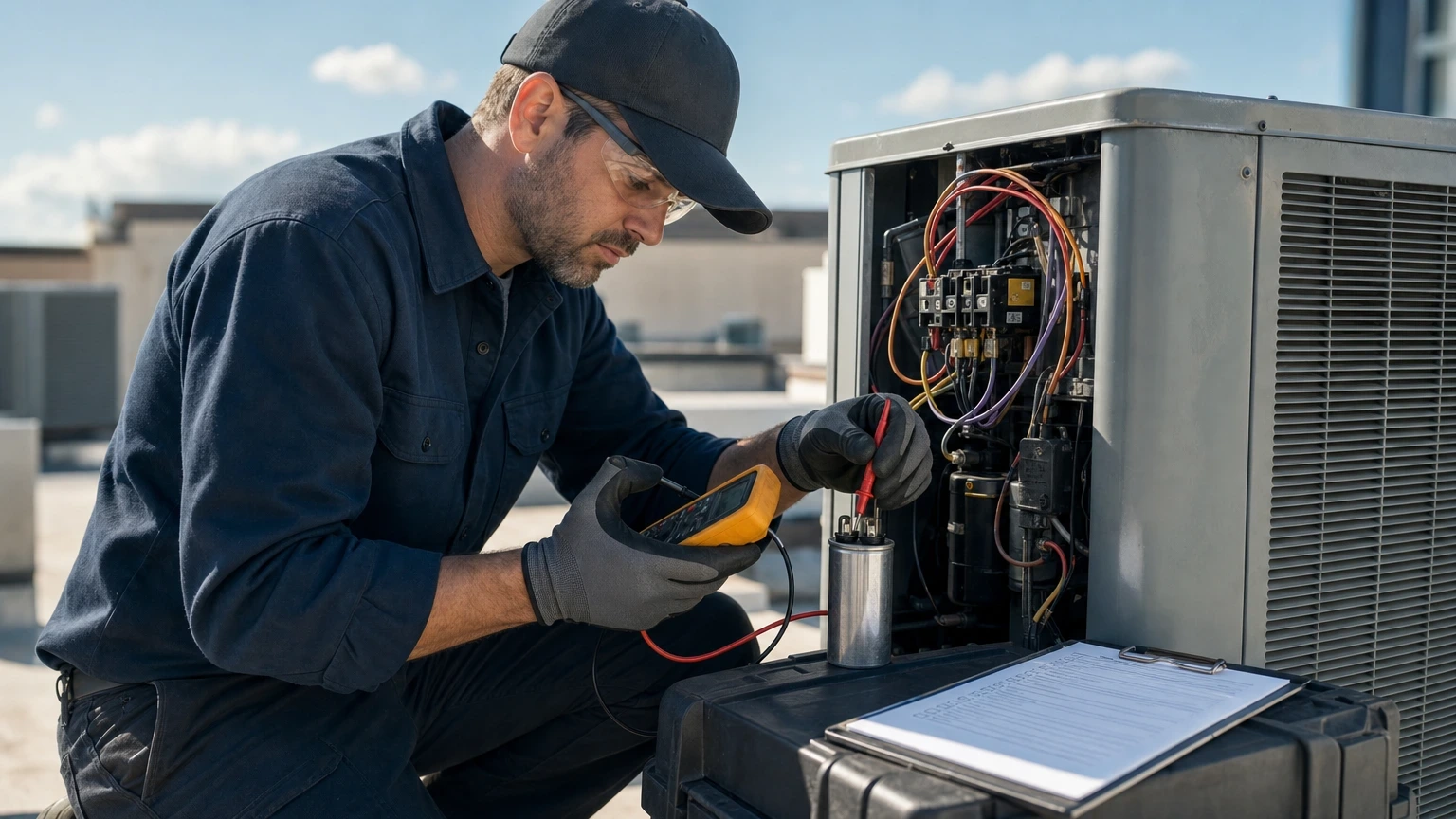
Your tech finishes a PM in 18 minutes. The customer calls back in three days with a dead capacitor. Meanwhile, now you’re eating a truck roll on a job that already made you no margin. That’s what happens without a real hvac maintenance checklist. Techs wing it, dispatch has no visibility, and your first-time fix rate quietly slides toward 70%.
A tight hvac maintenance checklist fixes that. It standardizes what gets checked and documents what was found. It also gives you a paper trail when a customer disputes a repair six months later.
Why Skipping a Standardized HVAC Maintenance Checklist Costs You Money
Every shop owner says they run maintenance agreements for recurring revenue. Few actually protect the margin on those visits.
A PM without a checklist turns into a “quick look and top off the freon” call. That’s a 20-minute visit charged like a 45-minute one. It also misses the failing contactor or the blower wheel packed with dust that turns into an emergency call next month. Emergency calls cost more to staff and disrupt your schedule. They also get billed at a lower effective rate once you factor in the diagnostic time nobody invoices for.
Shops running a documented checklist through something like ServiceTitan or Housecall Pro see the difference show up in two places: average ticket size on PM visits, and repeat-visit rate within 90 days. When techs follow the same 20-point routine every time, they catch the failing run capacitor before it strands a family in July. Then you bill for the replacement instead of eating a warranty callback.
There’s also the liability angle. A written checklist with signed findings protects you if a compressor fails two weeks after a “clean and check.” Without it, you’re arguing verbally against a homeowner who remembers things differently.
Building the Checklist Around Refrigerant, Electrical and Airflow
Most techs mentally sort a PM into three buckets, and your checklist should mirror that so nothing gets skipped when the customer is chatting them up about their thermostat app.
Refrigerant checks come first on cooling systems. That means superheat and subcooling readings against manufacturer spec, not just a glance at sight glass or gauge pressure. A tech pulls 8 degrees of subcooling on a TXV system when spec calls for 10-12. That reading points to a partial charge. It’s a callback waiting to happen if it’s logged as “checked, ok.”
Electrical is where most no-cool calls actually originate, not refrigerant. Capacitor readings against rated microfarad, contactor pitting, amp draw on the compressor and condenser fan motor compared to nameplate. A capacitor reading 35 mfd on a 40/5 rated dual-run cap is within tolerance today and dead in six weeks. Your checklist needs a pass/fail line with the actual reading recorded, not a checkbox.
Airflow rounds it out: static pressure readings at the return and supply, filter condition, blower amp draw, and coil cleanliness. A dirty evaporator coil dropping airflow by 15-20% shows up as high head pressure and short cycling. It is also the single most common thing techs skip, because pulling the panel to look costs an extra 10 minutes.
Seasonal Splits: What Spring PMs Need That Fall PMs Don’t
Running one generic checklist year-round wastes time on the wrong system half the year. Split it.
Spring PMs on cooling systems should front-load refrigerant charge verification, condenser coil cleaning (a hosed-down coil vs. a chemically cleaned one makes a real difference on efficiency), and condensate drain checks. A clogged condensate line is a five-minute fix in April and a water-damaged ceiling claim in July if it gets skipped.
Fall PMs on heating systems shift priority to heat exchanger inspection, combustion analysis, and gas pressure verification. This is the one section where cutting corners is genuinely dangerous. A cracked heat exchanger on a furnace missed during a rushed fall tune-up is a carbon monoxide risk, not just a comfort complaint. Techs should run a combustion analyzer, like a UEI Test Instruments unit, and log CO readings, not just eyeball the flame color.
Shoulder-season equipment, heat pumps mainly, needs both lists run partially. Refrigerant checks run year-round since the system works in both modes. Fall adds defrost cycle verification that a straight AC system never needs.
The Field-Ready HVAC Maintenance Checklist Template
Print this, laminate it, or build it into your CRM’s mobile form. Techs check boxes and record actual readings, not just pass/fail.
- Thermostat calibration and cycle test (heat and cool mode)
- Filter inspection, replace if MERV rating or dirt load requires it
- Evaporator coil visual inspection and cleaning as needed
- Condenser coil cleaning, record before/after head pressure
- Refrigerant charge check: superheat/subcool readings vs. spec
- Compressor amp draw vs. nameplate RLA
- Capacitor microfarad readings, both start and run
- Contactor condition, check for pitting and proper contact
- Condensate drain flow test and line clearing
- Blower motor amp draw and bearing check
- Static pressure reading, supply and return
- Ductwork visual inspection for disconnects or crushed runs
- Thermostat wiring and low-voltage connections
- Safety controls test: high/low pressure switches, float switch
- Heat exchanger visual and combustion analysis (heating systems)
- Gas pressure verification at manifold
- Flue and venting inspection for proper draft
- Electrical disconnect and breaker condition
- Overall system cycle test with runtime data logged
- Customer-facing summary sheet with readings and recommendations
Twenty line items sounds like a lot until you time it. A tech who knows the checklist cold runs it in 35-45 minutes on a straightforward split system, and that’s billable time, not overhead.
Getting Techs to Follow the HVAC Maintenance Checklist
The checklist is worthless if it lives in a binder nobody opens. This is where most shops lose the fight.
Paper checklists get filled out in the truck after the job, from memory, which defeats the entire point. Digital forms through platforms like ServiceTitan, FieldEdge, or Jobber force real-time entry because the app won’t let the tech close the ticket without required fields filled. That single change, forcing in-field entry instead of end-of-day recall, is the biggest lever for actual compliance.
Ride-alongs matter too. A service manager riding with a tech once a quarter, watching the actual PM get run, catches the guy who’s checking boxes without pulling gauges. That’s a training conversation, not a discipline conversation, but it has to happen or the checklist becomes theater.
Tie it to pay if you can. Techs who know their PM completion rate and accuracy affects their bonus structure treat the checklist differently than techs who see it as paperwork slowing down their day.
Comparing PM Software for HVAC Maintenance Checklist Delivery
Picking the right platform for checklist delivery matters more than the checklist content itself, because a clunky app kills compliance fast.
ServiceTitan
Built for larger residential shops running 10+ trucks. Custom form builder handles branching logic, so a failed capacitor reading can auto-trigger a recommended repair line item. Pricing is quote-based and sits on the higher end, but the reporting on PM-to-repair conversion is the strongest in the category.
Housecall Pro
Simpler interface, faster onboarding for smaller shops running 2-8 techs. Checklist templates are easy to build but less flexible on conditional logic. Pricing is more accessible for shops that don’t need the full enterprise feature set.
FieldEdge
Strong on the accounting integration side, particularly for shops already running QuickBooks. Checklist forms are solid but the mobile app has historically lagged the two above on speed and offline functionality, which matters in rural service areas with spotty signal.
Jobber
Best fit for smaller residential and light commercial operations that also need scheduling and invoicing in one tool without a steep learning curve. Checklist customization is more basic, but the price point makes it a reasonable starting platform before scaling to something heavier.
| Platform | Best For | Checklist Flexibility | Offline Mode |
|---|---|---|---|
| ServiceTitan | 10+ truck shops | High, conditional logic | Yes |
| Housecall Pro | 2-8 truck shops | Moderate | Yes |
| FieldEdge | QuickBooks-heavy shops | Moderate | Limited |
| Jobber | Small residential/light commercial | Basic | Yes |
Turning the HVAC Maintenance Checklist Into Repeat Revenue
A maintenance checklist isn’t just a quality control tool. Run it right and it becomes your sales engine for repairs and replacements.
Every reading a tech logs, that low subcooling number, the capacitor at 80% of rated capacity, the static pressure running high, becomes a documented reason for a follow-up quote. Customers trust a number on a page more than a verbal “it’s getting old.” Some shops train techs to walk the customer through the findings sheet at the end of the visit. That beats leaving it on the counter, and it lifts conversion on recommended repairs.
The checklist also protects your maintenance agreement renewal rate. Customers renew when they see their system got real attention, not a rushed filter swap. That documented history, visit after visit, is what makes a $180 PM visit feel worth it against a competitor undercutting you on price with a five-minute drive-by.
Build the checklist once and train it hard. Put it in a digital form your techs cannot skip past. It pays for itself in fewer callbacks and better repair conversion within a season or two.
Frequently asked questions
How often should commercial systems get an hvac maintenance checklist run?
Most commercial rooftop units need a full checklist run twice a year, spring and fall, with a lighter filter and belt check quarterly on heavy-use buildings like restaurants. Systems running near-constant loads, like server rooms or medical facilities, often justify quarterly full PMs instead.
What’s the difference between a residential and commercial hvac maintenance checklist?
Commercial checklists add belt tension and pulley alignment checks, economizer damper operation, and often VFD (variable frequency drive) verification that residential splits don’t have. Residential checklists spend more relative time on single-zone thermostat calibration and condensate handling since commercial units usually have better-engineered drainage.
Should techs use a paper checklist or a digital app in the field?
Digital wins almost every time because it forces real-time entry and syncs readings straight into the customer record for future reference. Paper checklists tend to get filled out from memory at the end of the day, which introduces errors and defeats the documentation purpose entirely.
How long should a proper PM visit take if the checklist is followed correctly?
A straightforward residential split system runs 35-45 minutes when a tech knows the checklist well and isn’t fumbling for tools or forms. Commercial rooftop units or systems with combustion analysis on the heating side often run 60-90 minutes depending on access and unit condition.
Does an hvac maintenance checklist actually reduce callback rates?
Yes, shops that standardize checklist use consistently catch failing components, like weak capacitors or partial refrigerant charges, before they cause a no-cool or no-heat emergency. The exact reduction varies by shop, but the mechanism is straightforward: documented readings catch marginal parts that a quick visual check misses.